Monday, June 5, 2017--Cordoba, Spain
We were up early to see the Mezquita (the former mosque which now has an entire Cathedral built inside its walls) before the arrival of the crowds for the day. We had set the alarm to be up at 7:30, but I had some trouble sleeping and never got back to sleep after awakening around 5:30. I read in my current book from about 6:00 and finally started my shower around 7:15.
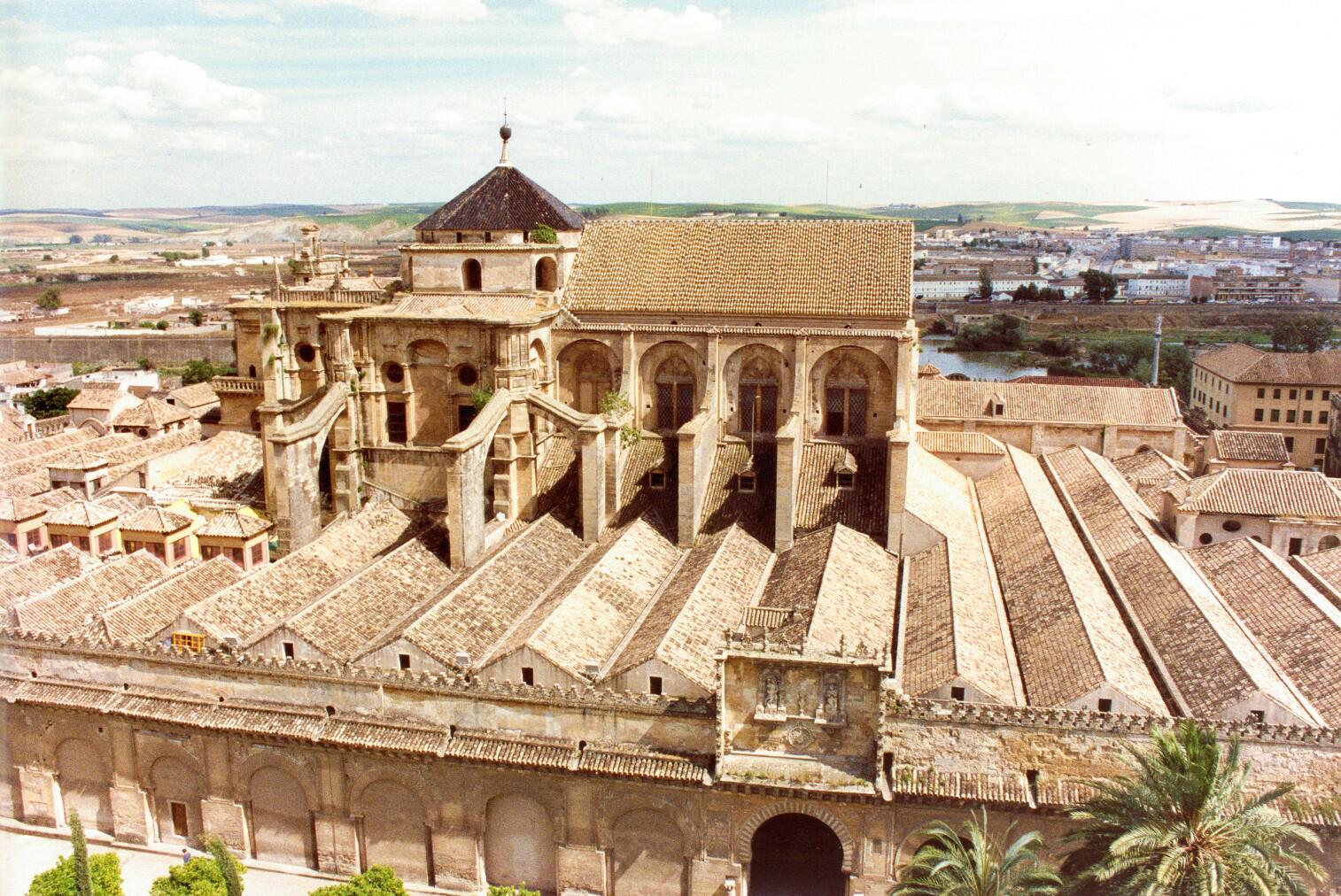
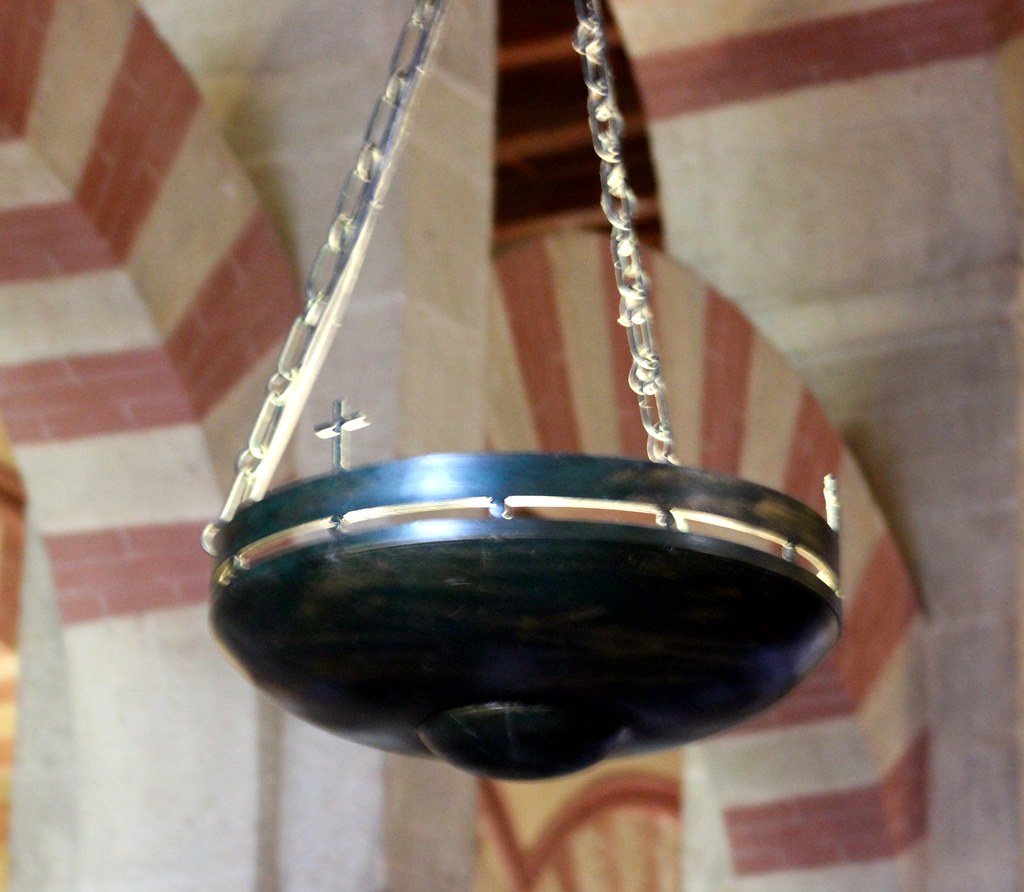
The Mezquita WAS a beautiful building. Parts of it still are. But almost all aspects of it have been altered to turn the entire building into a Christian one. That surprised me a bit. I had read how the city of Cordoba fought the government to avoid the building being altered and that the government had finally decreed that a huge church be built inside the center of the building (photo here where the outline of the church sticking up out of the building can be see and photos here where the church exists within the building. But so much more has been done. Light fixtures have been installed with crosses on them in beyond the interior of the church. Small Christian chapels have been built out from the side walls all around the interior of the Mezquita. Essentially what remains to show what a great mosque this was is the size of the interior (possibly only because to build a cathedral big enough to encompass the whole building would have been too expensive and large an undertaking), the many supporting columns and arches in Moorish design, some woodwork design in ceilings and wall panels, and some Arabic writing and Moorish designs in stone. Why is it necessary for religions to try to wipe out the beautiful architecture of others by forcefully changing their buildings to the religion of the conquerors? Today we decry the Taliban destroying old Roman or pagan temples that have stood for centuries, but we westerners tend to glorify the building of a church that greatly alters the interior of a wonderful centuries-old mosque. I walked through this building resenting the imposition of Christianity throughout and wishing I could have seen it in its original glory. It was one of the four greatest centers of Islam in the world in one of the largest cities of the world at one time. While there, an organist came to practice, and it was nice to hear his music. That was the only positive Christian experience I can say that I took away from the visit this morning.
After leaving there, we had a list of other sights to see before closing times this afternoon. Along the way, we also discovered other places we appreciated. We went to the Calle y Plaza de las Flores (a narrow street and small plaza with flower pots hanging on the walls and with a nice lined-up view back to the former minaret/now church tower of the Mezquita), the Casa Arabe (a group of several old homes/patios with Arabic cultural exhibits--paintings, music, etc.), the Casa Ramon Garcia (a wonderful small house built around a courtyard that houses exhibits and items for sale of leather work in the styles of guadamecies and cordobanes--the former where the leather is tooled and completely covered in silver and other shiny decorative details and the latter where the leather is only tooled and may have portions of it dyed), the beautiful multi-courtyard area with a well and flowers everywhere including on the walls of a small home at #4 Calle Trueque, and the very interesting Iglesia Parroquial de San Lorenzo.
On our way back to the hotel we shared a delicious ham and cheese empanada that had a really good flaky crust and a pastry made from the same crust with a filling of sweet cream and slices of dried apple and glazed which is one of the local Cordoba specialties. We returned through the Plaza del Potro just to see it again after reading that in one of the adventures of Don Quixote, he had lived at that square.
______
After tea and then happy hour at our room, we went out just to wander for a final time in Cordoba. We went up directions we had not gone since the first day here. Eventually, we ended up at the main square in the shopping district where we found an empty bench and sat watching people, listening to a man playing an accordion, and just visiting with each other.
There is a concert tonight we would have liked to have heard--part of the International Sephardic Music Festival that starts tonight. The performers tonight are Jasmina Petrovic and Klezmer Muzikanten. I may have heard them before at the Accordion Festival in San Antonio. But there concert tonight doesn't begin until 22:30, and we have to be up and traveling tomorrow morning to our next destination.
Monday, June 05, 2017

Sunday, June 04, 2017
Seeing the Sights that Will Not Be Open Tomorrow
Sunday, June 4, 2017--Cordoba, Spain
Weekends are a bit awkward for seeing sights anywhere, especially if you are not leaving on Monday. Every place is crowded with tourists on the weekend. Here in Spain where closing for the afternoon is ingrained in the culture, it means that many places are only open until 14:00 or 15:00 and then closed for the rest of the day. And if you aren't leaving on Monday, it means planning a Sunday schedule around what will be closed on Monday and saving places that will be open on Monday for that day.
We started this morning by wandering through the Jewish Quarter. It has even narrower streets than the rest of old town, and they twist and wind more. I imagine it was probably an intentional design to make it harder for people to come into their neighborhood and cause problems. Inside the quarter, we went into the old synagogue, one of only three remaining in all of Spain. It is a simple, small building with lots of carved designs and inscriptions on the walls.
All over town we have been able to see into beautiful gardens in courtyards. As we left the Jewish quarter, we passed several on our way across the old Roman Bridge to the very modern and new Centro de Arte Contemporaneo (here and here). There we saw a very interesting exhibit of work by Pepe Espaliu (information about the artist here and pictures of the artist and his works here.
We walked back across the river and went to the Museo de Bellas Artes which is rather small, but had some nice artwork. From there, we walked to Plaza de Corredera, a large enclosed square (only two corder exits and one side exit with no streets passing through it. It has a few cafes, and it has been used for bullfights before. Next, we went to Plaza de Colon, a small park dedicated to Christopher Columbus. After resting on a bench in front of the fountain watching people for a while, we left there to pass through Plaza Capuchinos which has a statue of Jesus that is popular. Usually people try to see it at night because of all the votive candles that are brought there regularly.
By then, it was getting hot and everything was closing for the afternoon. We wandered down one of the main shopping streets and though Plaza Tindillas. From there, we followed narrow old town streets with small cafes that were beginning to fill with people for afternoon drinks. As we approached our room, we encountered a group of women in flamenco dresses with a man playing a guitar while they sang as they moved down the street.
_____
In the early evening we went out again. We walked across the river again to explore neighborhoods over there. Then we returned near the Alcazar. It was already closed for the day, but we could see the beautiful gardens through the gate. We sat at a local park for a while watching the horse carriages leave with riders and the people wandering the area. We eventually returned home the long way through more of the old town streets getting back for the night (and a late happy hour) around 20:00.
Weekends are a bit awkward for seeing sights anywhere, especially if you are not leaving on Monday. Every place is crowded with tourists on the weekend. Here in Spain where closing for the afternoon is ingrained in the culture, it means that many places are only open until 14:00 or 15:00 and then closed for the rest of the day. And if you aren't leaving on Monday, it means planning a Sunday schedule around what will be closed on Monday and saving places that will be open on Monday for that day.
We started this morning by wandering through the Jewish Quarter. It has even narrower streets than the rest of old town, and they twist and wind more. I imagine it was probably an intentional design to make it harder for people to come into their neighborhood and cause problems. Inside the quarter, we went into the old synagogue, one of only three remaining in all of Spain. It is a simple, small building with lots of carved designs and inscriptions on the walls.
All over town we have been able to see into beautiful gardens in courtyards. As we left the Jewish quarter, we passed several on our way across the old Roman Bridge to the very modern and new Centro de Arte Contemporaneo (here and here). There we saw a very interesting exhibit of work by Pepe Espaliu (information about the artist here and pictures of the artist and his works here.
We walked back across the river and went to the Museo de Bellas Artes which is rather small, but had some nice artwork. From there, we walked to Plaza de Corredera, a large enclosed square (only two corder exits and one side exit with no streets passing through it. It has a few cafes, and it has been used for bullfights before. Next, we went to Plaza de Colon, a small park dedicated to Christopher Columbus. After resting on a bench in front of the fountain watching people for a while, we left there to pass through Plaza Capuchinos which has a statue of Jesus that is popular. Usually people try to see it at night because of all the votive candles that are brought there regularly.
By then, it was getting hot and everything was closing for the afternoon. We wandered down one of the main shopping streets and though Plaza Tindillas. From there, we followed narrow old town streets with small cafes that were beginning to fill with people for afternoon drinks. As we approached our room, we encountered a group of women in flamenco dresses with a man playing a guitar while they sang as they moved down the street.
_____
In the early evening we went out again. We walked across the river again to explore neighborhoods over there. Then we returned near the Alcazar. It was already closed for the day, but we could see the beautiful gardens through the gate. We sat at a local park for a while watching the horse carriages leave with riders and the people wandering the area. We eventually returned home the long way through more of the old town streets getting back for the night (and a late happy hour) around 20:00.
Saturday, June 03, 2017
Slow/Fast Train to Cordoba
Saturday, June 3, 2017--Ronda to Cordoba
When we bought our train tickets, Wes was surprised at the cost (about 30 Euros each). The woman explained that it was a fast train. When the train pulled into the station, it didn't look like a fast train. And for the first hour of the less-than-two hour trip, it wasn't. Then we passed the way-out-in-the-country station of Santa Ana/Antequera, we joined the fast-train tracks between Malaga and Cordoba. We went a little faster, but then we pulled over and waited for another train to pass. With only about 35 minutes left before our expected arrival and about 40% of our distance still ahead of us, we finally started moving fast. It was so fast, that we made that 40% of the trip in only 30 minutes with 5 minutes to spare. If it had been a fast train all the way, we would have traveled only about 1 hr. 10 minutes compared to the scheduled 1 hr. 55 minutes.
We are staying at another place that is called a hostel but really isn't one. It is the Hostal Azahar which is just across the street from the main tourist sight in Cordoba--the Mezquita (the old mosque). Our room is very nice and has a patio area outside it that we will enjoy using.
Walking from the train station, we came through the Old Town--the largest in Europe. In a brief outing after checking in and walking around the corner to the tourist office, we saw the old Roman Bridge, the Puerta del Puente (old gate), the walls around the Mezquita, and an art exhibit at the Centro de Arte Contemporaneo on the history of Flamenco. It included a beautiful photograph of Lola Flores whose statue was just outside our apartment in Jerez.
We have finally hit hot weather, so after buying some happy hour supplies we returned to the room to take advantage of the air conditioner for a while. We are mapping out a plan for what to see and when to see it using information we got at the tourist office.
________
We went back out in the early evening just wandering randomly. The Old Town of Cordoba is so big that it is easy to do that day after day. (Around the year 1000, Cordoba already had 500,000 residents!) We aimed toward the northeast, because the tourist office had told us about a concert up there. On the way, we passed another art exhibit which we saw--works by Toni Soto. (Note: It is difficult to find any of her work; only the first 3 photos on the link are related to her and her works.) A few minutes later, we came to a square that had many people dressed in white and a choir singing Aquarius (the 4th Dimension song). Eventually, a drum/dance group led the crowd away from the square. We never figured out what it was about.
We made it to the concert. It was in a former church. A string quartet of young people called Cuarteto Haendel de Puertos del Estado. They played two pieces, each with four parts--one by Verdi and another by Brahms--and finished with an encore. They were very good and had all graduated from the Queen Sofia School of Music.
Walking back home via a different route, we kept passing full plazas and bars where people were watching a futbol (soccer) game with Real Madrid, one of the major teams in Spain. Every time there was a score, there would be roars! Back in the room, we prepared for bed!
When we bought our train tickets, Wes was surprised at the cost (about 30 Euros each). The woman explained that it was a fast train. When the train pulled into the station, it didn't look like a fast train. And for the first hour of the less-than-two hour trip, it wasn't. Then we passed the way-out-in-the-country station of Santa Ana/Antequera, we joined the fast-train tracks between Malaga and Cordoba. We went a little faster, but then we pulled over and waited for another train to pass. With only about 35 minutes left before our expected arrival and about 40% of our distance still ahead of us, we finally started moving fast. It was so fast, that we made that 40% of the trip in only 30 minutes with 5 minutes to spare. If it had been a fast train all the way, we would have traveled only about 1 hr. 10 minutes compared to the scheduled 1 hr. 55 minutes.
We are staying at another place that is called a hostel but really isn't one. It is the Hostal Azahar which is just across the street from the main tourist sight in Cordoba--the Mezquita (the old mosque). Our room is very nice and has a patio area outside it that we will enjoy using.
Walking from the train station, we came through the Old Town--the largest in Europe. In a brief outing after checking in and walking around the corner to the tourist office, we saw the old Roman Bridge, the Puerta del Puente (old gate), the walls around the Mezquita, and an art exhibit at the Centro de Arte Contemporaneo on the history of Flamenco. It included a beautiful photograph of Lola Flores whose statue was just outside our apartment in Jerez.
We have finally hit hot weather, so after buying some happy hour supplies we returned to the room to take advantage of the air conditioner for a while. We are mapping out a plan for what to see and when to see it using information we got at the tourist office.
________
We went back out in the early evening just wandering randomly. The Old Town of Cordoba is so big that it is easy to do that day after day. (Around the year 1000, Cordoba already had 500,000 residents!) We aimed toward the northeast, because the tourist office had told us about a concert up there. On the way, we passed another art exhibit which we saw--works by Toni Soto. (Note: It is difficult to find any of her work; only the first 3 photos on the link are related to her and her works.) A few minutes later, we came to a square that had many people dressed in white and a choir singing Aquarius (the 4th Dimension song). Eventually, a drum/dance group led the crowd away from the square. We never figured out what it was about.
We made it to the concert. It was in a former church. A string quartet of young people called Cuarteto Haendel de Puertos del Estado. They played two pieces, each with four parts--one by Verdi and another by Brahms--and finished with an encore. They were very good and had all graduated from the Queen Sofia School of Music.
Walking back home via a different route, we kept passing full plazas and bars where people were watching a futbol (soccer) game with Real Madrid, one of the major teams in Spain. Every time there was a score, there would be roars! Back in the room, we prepared for bed!
Friday, June 02, 2017
Final Ramblings in Ronda
Friday, June 2, 2017--Ronda, Spain
I began the day by getting a haircut. I had been needing one for a while, but I hadn't organized myself for one. That means that I had not used Google Translate to create a list of specifics about what I wanted done in Spanish. But while Wes was lingering in the bathroom this morning, I did my translation and then went to a barber shop I had seen yesterday. It was a nice young man who spoke a little English, but read my list and understood exactly what I wanted. He took his time and did a good job of cutting. At the end, I told him he could take my list (including my sketches) to a party to have a good laugh with his friends. He put it in a drawer and said in English, "For my collection." The haircut cost only 6 Euros. I gave him an extra one even though he was the owner of the shop, since he had to deal with the language barrier with me.
Today was a wrap-up day in Ronda. We went into local neighborhoods to see some old churches and an old public fountain. We crossed two other bridges, including one they call the old Arab bridge but which was also the site of a Roman bridge earlier, at lower levels than the high one over the gorge. We went by the ruins of the old Arab baths.
Back in the hotel for part of the afternoon, we got caught up on reading news stories and did some time researching some of the sights we have seen here. I also reviewed and highlighted the literature for our next stop tomorrow.
We had an early dinner of pizza and beer, since Spanish restaurants don't really serve meals until late in the evening. Then we wandered some of the viewpoints of the city again before returning here for the night.
I began the day by getting a haircut. I had been needing one for a while, but I hadn't organized myself for one. That means that I had not used Google Translate to create a list of specifics about what I wanted done in Spanish. But while Wes was lingering in the bathroom this morning, I did my translation and then went to a barber shop I had seen yesterday. It was a nice young man who spoke a little English, but read my list and understood exactly what I wanted. He took his time and did a good job of cutting. At the end, I told him he could take my list (including my sketches) to a party to have a good laugh with his friends. He put it in a drawer and said in English, "For my collection." The haircut cost only 6 Euros. I gave him an extra one even though he was the owner of the shop, since he had to deal with the language barrier with me.
Today was a wrap-up day in Ronda. We went into local neighborhoods to see some old churches and an old public fountain. We crossed two other bridges, including one they call the old Arab bridge but which was also the site of a Roman bridge earlier, at lower levels than the high one over the gorge. We went by the ruins of the old Arab baths.
Back in the hotel for part of the afternoon, we got caught up on reading news stories and did some time researching some of the sights we have seen here. I also reviewed and highlighted the literature for our next stop tomorrow.
We had an early dinner of pizza and beer, since Spanish restaurants don't really serve meals until late in the evening. Then we wandered some of the viewpoints of the city again before returning here for the night.
Thursday, June 01, 2017
Traveling the Ruta de los Pueblos Bancos
Thursday, June 1, 2017--Jerez de la Frontera to Ronda
Our bus trip today took us along 2-lane highways along the Ruta de los Pueblos Blancos--a highway that connects many of the famous white villages of Spain (quaint, beautiful places in the mountains in which most of the buildings are stucco painted white). (Note: A right-click on the mouse should give you an options that will include using Google Translate to translate the linked webpage into English.) Among the ones we went through were the outstanding Arcos de la Frontera, Bornos, Villamartin, Puerto Serrano, Algodonales, and El Gastor. We could see the beautiful Zahara in the distance, and, of course, we ended in Ronda.
We are staying at the Hotel Royal which is in a good location to explore the city as well as for getting in and out of it. It's a simple room with a good a/c and acceptable WiFi. The town itself is so crowded with groups of tourists wandering everywhere that it wasn't very easy to walk to the hotel (even though it was just a few blocks).
_________
Ronda is built on two sides of the El Tajo Gorge. The old city is on one side and the "new" city (maybe 200 years old) is on the other. We went out this evening to see the city without the hoards of group tourists that were everywhere during the daytime. We walked straight down our street past the bullring to the gorge where we looked out both directions. Then we continued into the old town which is very atmospheric.
Toward the end of the old town, we went into two different churches with interesting experiences. Both were associated with convents. When we entered the first one, no one was in church, but we could hear a group of unseen nuns chanting. They continued until Wes sat down and the pew creaked. Then they stopped. It may have been coincidental, but I'm not convinced that it was. In the next chapel, we entered and there were nuns in their black habits sitting quietly and praying in the front. What I found interesting is that about 2/3 of them were seated in the pews, but the others were seated directly on the floor.
Continuing to wind through the narrow streets of the old town, we came to a path that takes people down into the gorge for a look back up to the city. The sun was positioned just right for photos, so we decided not to wait to hike there tomorrow. We went down and down and down the trail until we came to a small viewing area. It provided a perfect location for taking photos, for appreciating the construction of the bridge over the gorge, and for admiring the city on top of the stone mountains on either side of it. The climb back up was long and hard. It was just so far and so steep. We stopped three times to rest in the shade.
When we got to the top, it was at a small green plaza with beautiful trees and flowers with several tables of diners at a sidewalk cafe. A man was playing a guitar--a variety of Latin melodies that I knew well. We just sat and enjoyed the mellow music and the evening as people walked by us.
Our bus trip today took us along 2-lane highways along the Ruta de los Pueblos Blancos--a highway that connects many of the famous white villages of Spain (quaint, beautiful places in the mountains in which most of the buildings are stucco painted white). (Note: A right-click on the mouse should give you an options that will include using Google Translate to translate the linked webpage into English.) Among the ones we went through were the outstanding Arcos de la Frontera, Bornos, Villamartin, Puerto Serrano, Algodonales, and El Gastor. We could see the beautiful Zahara in the distance, and, of course, we ended in Ronda.
We are staying at the Hotel Royal which is in a good location to explore the city as well as for getting in and out of it. It's a simple room with a good a/c and acceptable WiFi. The town itself is so crowded with groups of tourists wandering everywhere that it wasn't very easy to walk to the hotel (even though it was just a few blocks).
_________
Ronda is built on two sides of the El Tajo Gorge. The old city is on one side and the "new" city (maybe 200 years old) is on the other. We went out this evening to see the city without the hoards of group tourists that were everywhere during the daytime. We walked straight down our street past the bullring to the gorge where we looked out both directions. Then we continued into the old town which is very atmospheric.
Toward the end of the old town, we went into two different churches with interesting experiences. Both were associated with convents. When we entered the first one, no one was in church, but we could hear a group of unseen nuns chanting. They continued until Wes sat down and the pew creaked. Then they stopped. It may have been coincidental, but I'm not convinced that it was. In the next chapel, we entered and there were nuns in their black habits sitting quietly and praying in the front. What I found interesting is that about 2/3 of them were seated in the pews, but the others were seated directly on the floor.
Continuing to wind through the narrow streets of the old town, we came to a path that takes people down into the gorge for a look back up to the city. The sun was positioned just right for photos, so we decided not to wait to hike there tomorrow. We went down and down and down the trail until we came to a small viewing area. It provided a perfect location for taking photos, for appreciating the construction of the bridge over the gorge, and for admiring the city on top of the stone mountains on either side of it. The climb back up was long and hard. It was just so far and so steep. We stopped three times to rest in the shade.
When we got to the top, it was at a small green plaza with beautiful trees and flowers with several tables of diners at a sidewalk cafe. A man was playing a guitar--a variety of Latin melodies that I knew well. We just sat and enjoyed the mellow music and the evening as people walked by us.
Subscribe to:
Posts (Atom)